The Arthur Honegger Centenary / Centenaire d’Arthur Honegger vol. 1 – The Human Tragedy / La Tragédie Humaine: Les Cris du Monde (Helena Tattermuschova Vera Soukupova, Jaroslav Majtner, Prague Philharmonic Chorus, Prague Symphony Orchestra, Serge Baudo), Symphony No. 3 “Liturgique” (Prague Radio Symphony Orchestra, Mario Klemens). Praga PR 250 000 (1992) barcode 3149025050908
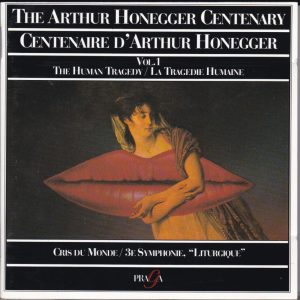
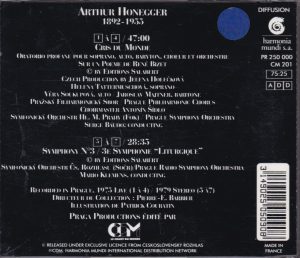
A much-needed version in stereo of Honegger’s “Cris du Monde” – but, alas! a flawed production
Orginally posted on Amazon.com, 27 June 2013
Honegger’s Oratorio “Cris du Monde” (“Cries” or “Shouts of the World”) is a rare, interesting and flawed composition. Completed in 1931, it partakes in many ways of the trend and interest that gave birth to such evocations in music of the machines as Honegger’s Pacific 231, Mossolov’s Iron Foundries or Frederick Shepherd Converse’s “Flivver Ten Million” (the latter on Louisville First Edition Encores, Albany Troy 030 barcode 034061003021, with works of Arthur Bird, Frederick Converse, George Chadwick, Arthur Foote), or the paintings of Fernand Léger and the photographic work of Lewis Hine. But where these works expounded an optimistic and triumphant glorification of technical progress and the machines, “Cris du Monde” is branded by the mark of the great depression, and illustrates the pessimistic view (think also of Chaplin’s The Modern Times or Fritz Lang’s Metropolis), man crushed by the machines, workers toiling hopelessly in factories, armies marching to endless wars, and the individual crying for an unobtainable solitude.
There’s a lot of great music in “Cris du Monde”, with novel orchestral and choral effects including a choral sprechgesang reminiscent of the one used by Milhaud in “Les Choéphores” and choral evocations of cacophonous crowds (last part, track 5), and traversing many moods, sardonic like a berserk Sorcerer’s Apprentice, stark, somber, with some menacing and pounding passages strikingly anticipating “La Danse des Morts”, brooding and meditative (a lot), ethereal, angelic, cosmic, grandiose – Honegger believed in his own score, was affected by its failure and regularly tried to get it revived and accepted by the audiences, but to no avail.
Listening to it, no wonder. It isn’t just that the music is “difficult”: other than in the last part, it isn’t. But it is also a very flawed work. The text by the journalist René Bizet tries to say too much and ends up being naïve and grandiloquent, and his poetry tries to be modern and ends up being just pretentious and fabricated, making Honegger’s music often sound without purpose. That the whole ideology – “the revolt of the individual against the masses that crush him”, in the composer’s own words – was taken deep at heart by Honegger and shared by him with utmost sincerity doesn’t make it less naïve and grandiloquent (Wagner’s operas also revolve around similar themes, only with him the individual is the “great and unrecognized artist”, e.g. Richard Wagner).
Baudo offers a good performance, constantly more urgent than the old one of Tzipine from 1957 (46:15 vs 53:35, see my review of Les Rarissimes de Arthur Honegger – link will open a new tab), and of course in incomparably better sound, but the production is also flawed. First, it is sung in a Czech translation. Well, sure, for the Czech audience at the concert somewhere in 1973 (it may be 1975, Praga’s white on black print is illegible), I get the point, very useful. But for the international audience at which the CD is aimed? It is a small casualty that it puts paid to Honegger’s very idiosyncratic rhythmic writing for the voices, in which the first syllable is often stressed rather than, as in spoken French, the last one. But to make matters worse, while the French text is given, as well as a German translation (but not side by side), no English translation is provided, just a synopsis. Goodbye international audience. And even if you are fluent in French, because the Czech text isn’t given and because the Oratorio doesn’t receive enough cues (the booklet announces 8, but there are only 4), you risk rapidly getting lost, and ending up listening as “pure” music, with only a vague notion of – or even interest for – what is being sung. So English-speaking audiences do not need to worry: they are treated no worse than the French ones.
Finally, the voices, timbres and vibrato aren’t very appropriate either: they sound very Slavic, great for an opera of Dvorak, Smetana or Janacek but not well-suited to Honegger. While Vera Soukupova is acceptable because a big-voiced Slavic contralto will always bring back echoes of Prokofiev’s Alexander Nevsky, baritone Jaroslav Majtner doesn’t come near emulating the simple nobility of Tzipine’s Michel Roux, and soprano Helena Tattermuschova has a childish, nasal timbre that may be suited for Janacek’s Cunning Little Vixen (a role she sung according to her bio in the booklet) or a soubrette, but sounds pretty awful in Honegger’s “Feminine Voice”. The Czech language and the motoric aspect of some parts of the music make it sound like Martinu rather than Honegger at times.
The old Tzipine recording remains a better choice then, although far from an ideal one: it comes in old French mono and the reissue on “Les Rarissimes” does not provide a libretto at all – goodbye again international audiences. “Cris du Monde” is still in need of a serious, dedicated modern recording – sung in French, and coming with complete text and translation.
As a substantial complement to its flawed “Cris du Monde”, Praga offers a performance of Symphonie “Liturgique” (No. 3), recorded in 1979. Usually the series has released live recordings (“Cris du Monde” is), but I hear no audience noise whatsoever. Maybe a studio recording made for radio broadcast. With “Liturgique” being one of Honegger’s most popular works on disc, and with great versions by Baudo, Mravinsky, Karajan, Järvi or Jansons, you’d think Praga might have found something more attractive than a version by an orchestra as unglamorous as the Prague Radio Symphony Orchestra and a conductor called Mario Klemens, hitherto unknown to me. In fact, the offering is a much better one than it seems.
First, its underlying program makes “Liturgique” a perfect illustration of the general theme and heading of this volume 1, “The Human Tragedy”, and an entirely appropriate companion to “Cris du Monde”. Therein, a depression-ridden Honegger sought to depict the triumph of stupidity and mankind’s taste for self-destruction (in which he included bureaucracy and taxes, a tea-partier “avant-la-lettre”) leaving only a glimmer of hope, the song of the Dove of Peace, the “utopian evocation of what life could be like in brotherhood and mutual love”.
Second, the 1979 sonics are excellent, although the all-important horns in the Finale aren’t quite as vivid and potent as they ideally should be, and the short but important passage for tenor drum (“caisse roulante”) in the same movement, between 5:02 and 5:30, doesn’t register with enough impact (recordings where it does seem to use in fact a snare drum).
Finally, the orchestra plays with great vehemence, lacking only, in the first movement, the touch of breathless urgency that marks the truly great versions of Baudo, Mravinsky, Järvi and Jansons (Karajan adopted a more expansive view, but with impressive orchestral potency). The second movement flows naturally, spot on the score’s metronome mark (the conductor in his recording from circa 1948 took it much more slowly, and it felt staid, see my review of Music & Arts CD 767) and with again great vehemence in the climaxes. A special highlight in the Finale are the blasting timpani and bass drum, and another is how close, section after section, Klemens’ tempi and timings are to Baudo’s studio recording, with another orchestra from Prague, the Czech Philharmonic, in 1960 (see link above). I wouldn’t be surprised if the conductor had listened a lot to the version of his predecessor to learn the piece. But the more vivid sonics of Baudo here (though not on the side drum) give him more impact.
This is not the CD I’d recommend for your version of the “Liturgique”, but as a substantial complement to “Cris du Monde” it is very welcome. But the problem remains this flawed production of “Cris du Monde”. Your choice now.