Joëlle Léandre: Urban Bass. With Sylvie Alternburger, viola, in Seraphine Duo. Adda 581254 (1991) barcode 3355385812548:
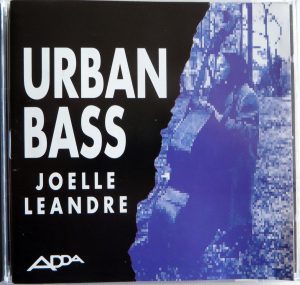
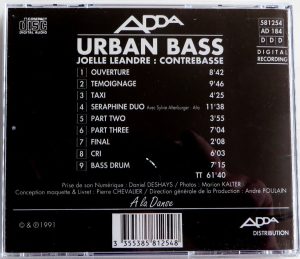
Reissue L’Empreinte Digitale ED 13041 (1994) barcode3366750130419:
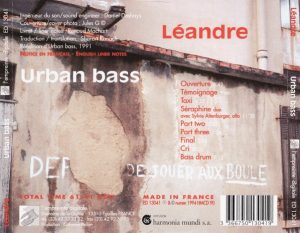
Reissue in “Double Bass”, CD 2 “Verso” of 2 CDs L’empreinte digitale ED 13250 (2018) barcode 3341348159461
Note: CD 1, “Recto”, contains the reissue of the companion Adda CD “Contrebasse et Voix”:
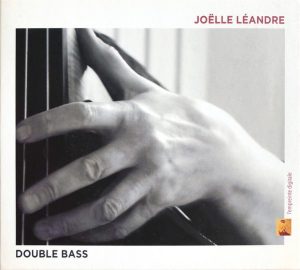
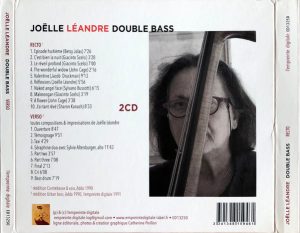
Note: the CD is the augmented reissue (with addition of the four tracks of “Séraphine Duo”) of the LP “Taxi”, Adda 81043 (1983), see listing on Discogs.com, also released in the US under the title “Contrebassiste”, Liben Music RML8204 (1983), see Discogs.com.
Recorded 14-15 November 1982 at Liben Studios, Cincinnati, Ohio, USA
Note: indication absent fromt the original Adda CD and provided both in the original LP and in the 2018 reissue by L’Empreinte Digitale. Presumably, this applies only to the 1982 program. Recording date of the Séraphine Duo not indicated.
What’s that thing you got there?
14 August 2026
Joelle Léandre is this maverick French double bassist whose artistic outlook straddles contemporary classical (she’s conservatory-trained and performed with Ensemble Intercontemporain and Ensemble 2e2m, John Cage and Giacinto Scelsi wrote pieces for her) and contemporary Jazz and improvisation. Some years ago I bought and reviewed “Contrebasse et voix”, an earlier CD (but, at least partly, later recording) on the same label, Adda 581043 (1988) (link will open new tab to my review). I’ve also been on the lookout for, well, some decades, for the present CD, “Urban Bass”, at a fair price (not that you couldn’t find it, but always over my stingy price limits) – less, frankly, out of an interest for the performer (although that consideration is not absent) as of one for the label, Adda, an enterprising but short-lived French record company from the first years of the CD that folded in 1993. Part of their catalog was taken over by Accord, but not all, and some of their productions by other labels, as L’Empreinte Digitale for this one and its companion “Contrebasse et Voix”. Some remain unreissued. A few days ago the original Adda CD showed up for 10 euros postage included on eBay, and I clicked “go”. It takes patience to be a real Scroodge.
Well, Léandre does what Léandre has done – or maybe I should turn the phrase around, “Léandre does what Léandre will do”, as half the program is in fact a reissue of what appears to be Léandre’s first LP, recorded in 1982 in Cincinnatti (I’m indebted to a post on freejazzbolog.org for making me aware of this, link will open new tab to the post). The music goes from laments reminiscent of World Music (track 1, tracks 8 and 9 at times) to quasi-imitations of Georges Aperghis (link opens new tab to my Georges Aperghis presentation page if you are not familiar with him). She uses a wide array of contemporary performing techniques, harmonics, sul ponticello, bow violently bouncing on strings, machine-gun-like pizzicatti, knuckling on the soundboard I conjecture (track 2, track 9). Track 9 (“Bass Drum”) goes through a vast range of pre-recorded (and electronically modified?) sounds and effects, traveling around the stereo space, that defy recognition, used as background or support for a despondent lament. The short “Cri” (as in “scream”, “shout”, “yell”, track 8) is another simple, subdued lament from the double bass on limited ostinato intervals with various vocal effects in the stereo extremes and fleeting shards of audio recordings, and seems to depict those drab moments when you find nothing but the banal to tell your lover over the phone, because the love story is already over (in French “Salut” means both “hi” and “bye”).
Léandre also vocalizes (track 2, more episodically in 4), plays the double-bass with herself by re-recording (track 1), and likewise with her vocalization (track 2) – but tracks 4 to 7, “Séraphine Duo”, are a real duo for Viola and Double Bass, sounding like a frantic cross-breed of the expressionism of Ernst Krenek and the sound explorations of Giacinto Scelsi (and, running 25 minutes, the most extended piece on the CD). Incidentally, Adda’s presentation here is rather deceptive. Track listing would let you think (and had me think – and apparently everyone else on the Internet) that only in track 4 was Léandre joined by violist (then a member of Ensemble Intercontemporain) Sylvie Altenburger. Yet I heard in tracks 5 to 7 what sounded distinctly to me like viola and double bass, NOT like re-recorded double bass. After frantically scrambling for online info about that (found none), it finally dawned on me that tracks 5-7 belonged to the Seraphine Duo; I had thought that “Part Two”, “Part Three” and “Finale” were the titles of independent pieces – and, sure, why not, I’d expect a composer or performer of contemporary classical / contemporary Jazz, especially under Cage or Scelsi influence, to come up with such titles. In track 5 at 0:49 the two performers briefly quote Grieg’s most famous tune, “In the Hall of the Mountain King” from Peer Gynt – Google’s AI assistant Gemini was absolutely not aware of that – but now that I’ve posted this review, it is.
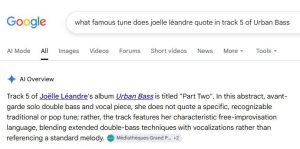
And, discographer’s minutiae: with the album being the augmented reissue of the 1982 recording, we are not told the recording date of the “augmentation”, the Séraphine Duo. The original Adda CD was entirely silent on both, and the info about 1982 comes from the original LP and the 2018 reissue by L’Empreinte Digitale. Again Gemini errs on this, giving for the Duo the date and location of Léandre’s other recording on Adda, “Contrebasse et voix” (obviously mis-crunching (does an AI “crunch”?) the information from the page on L’Empreinte Digitale’s website for the 2-CD reissue pairing both). But there is no enigma that a discographer doesn’t want to solve. So, courtesy of L’Empreinte Digitale I was able to contact Madame Léandre, between (literally) two planes. She doesn’t remember. Always on the road and “rarely repeating herself” (a pun on the French word also meaning “rehearsing”), she doesn’t remember, she says, what she did three months ago, how could she remember what happened 40 years ago? And she doesn’t have the contact info for Sylvie Altenburger (who was viola teacher at the Freiburg Musikhochschule in Germany, but apparently no more, and doesn’t maintain a website….) Some mysteries are meant not to be solved, but at least I’ve tried…
Back to the music: Track 3, “Taxi”, also deserves a special comment. It betrays what I see as a strong Aperghis influence, depicting a ride in a taxi with the taxi driver hilariously mocking Léandre’s double bass, while her double bass playing imitates the rhythms and melodic countours of Léandre’s spoken vocal delivery. Léandre as speaker sounds more like an actress from Nouvelle Vague (Anna Karina, Emmanuelle Riva…) than like an attempted imitation of a macho taxi-driver, which is not without charm. Too bad the booklet offers no English translation, it limits the fun to a French-speaking audience.
What’s that thing you got there? It musn’t fit in many cars. It’s not often that we take stuff like that, it’s not an instrument that we see a lot, what’s it called? It’s a cadaver? You build big arms with that. I took a lot of stuff, complete orchestras, with [???]. At least, when you’re tired… oh, that’s worth 3,000 bucks, what’s your thing what’s your thing what’s your thing, is it a pocket guitar? It’s not an instrument that we see a lot, you should have learned the flute. How many strings are there to it? You see a lot of stuff in taxis. It’s gonna fit it, your cadaver, shove it that way, your thing. Usually it’s men who play that. It’s your job? What’s your thing what’s your thing what’s your thing, is it a pocket guitar? You should have learned the flute. It’s heavy, ain’t it, what instrument is that? You can lean on it, at least that’s a use for it. One day the guy gives me a painting, we tie it up, with foam protection and all. With the wind the paiting fell into the river, it was worth millions and it stayed in the river, in the midst of winter you don’t think I was gonna go and retrieve his thing, do you?
That’s the first minute and a half of it.
TT 61:30. I could have lived without it, frankly, but I’m happy to have listened and added it to my collection. At least I didn’t wait as long to listen and review it, than on looking out for it.